Bond investing for retirement sets the stage for this enthralling narrative, offering readers a glimpse into a story that is rich in detail with a focus on securing financial stability for the future. Exploring the world of bonds for retirement opens up a realm of possibilities and strategic financial planning.
As we delve deeper into the nuances of bond investing for retirement, a clearer picture emerges of the importance, benefits, and risks associated with this investment strategy.
Introduction to Bond Investing for Retirement
Investing in bonds for retirement is a crucial strategy for building a stable financial future. Bonds are fixed-income securities issued by governments, municipalities, or corporations to raise capital. When you invest in bonds, you are essentially loaning money to the issuer in exchange for regular interest payments and the return of the principal amount at maturity.Including bonds in your retirement investment portfolio is vital for diversification and risk management.
Bonds provide a steady income stream, lower volatility compared to stocks, and act as a cushion against market fluctuations. They offer a level of predictability and stability that can help preserve your capital and generate income during retirement.
The Importance of Bonds in Retirement Investing
- Bonds offer a reliable source of income through interest payments.
- They provide capital preservation and act as a hedge against market volatility.
- Adding bonds to your portfolio can help balance risk and return, especially as you near retirement age.
Benefits and Risks of Bond Investments for Retirement
- Benefits:
Bonds offer steady income, diversification, and capital preservation.
- Risks:
Interest rate risk, inflation risk, and credit risk are key factors to consider when investing in bonds.
Types of Bonds for Retirement
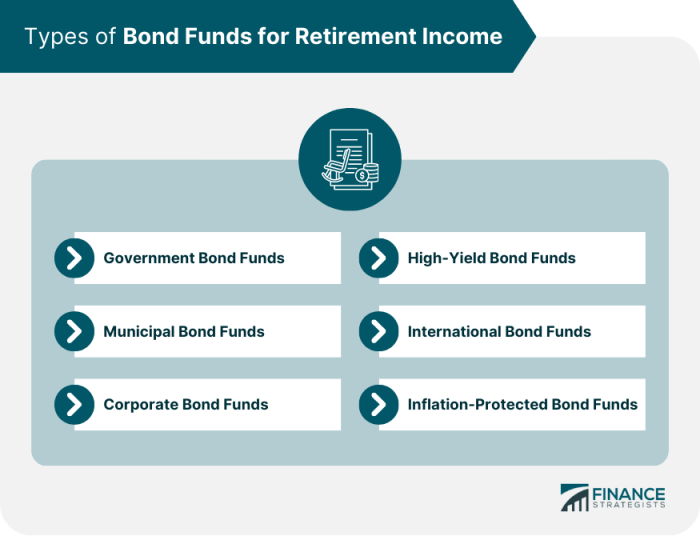
When considering bond investments for retirement, it’s important to understand the various types of bonds available and their differences in terms of risk and return.
Government Bonds
Government bonds are issued by national governments and are considered one of the safest investments. They offer low risk but typically lower returns compared to other types of bonds. These bonds are backed by the government’s ability to tax its citizens to repay the debt.
Corporate Bonds
Corporate bonds are issued by corporations to raise capital. They tend to offer higher returns than government bonds but come with a higher level of risk. The risk associated with corporate bonds depends on the financial stability of the issuing company.
Municipal Bonds
Municipal bonds are issued by state and local governments to fund public projects. They offer tax advantages and are relatively safe investments. Municipal bonds are considered to have moderate risk compared to government and corporate bonds.
Diversification Benefits
Diversifying your retirement portfolio with different types of bonds can help reduce overall risk. By investing in a mix of government, corporate, and municipal bonds, you can potentially achieve a balance between risk and return. This diversification strategy can help protect your retirement savings from fluctuations in any one sector of the bond market.
Factors to Consider When Choosing Bonds for Retirement
When selecting bonds for retirement, it is crucial to consider various factors that can impact the performance and stability of your investment portfolio. Factors such as duration, credit quality, and yield to maturity play a significant role in determining the suitability of a bond for retirement purposes.
Duration
Duration is a measure of a bond’s sensitivity to interest rate changes. Bonds with longer durations are more sensitive to interest rate fluctuations, making them riskier investments in a changing interest rate environment. For retirement purposes, it is generally recommended to choose bonds with shorter durations to minimize interest rate risk and maintain portfolio stability.
Credit Quality
Credit quality refers to the creditworthiness of the issuer and the likelihood of default. Bonds with higher credit ratings are considered safer investments as they have lower default risk. When choosing bonds for retirement, it is advisable to prioritize bonds with investment-grade credit ratings to ensure a more secure and reliable income stream during retirement.
Yield to Maturity
Yield to maturity is the total return anticipated on a bond if held until maturity, taking into account the bond’s current market price, par value, coupon interest rate, and time to maturity. It is essential to consider the yield to maturity when selecting bonds for retirement, as it provides insight into the potential returns of the investment over time. Bonds with higher yields to maturity may offer greater income potential but often come with increased risk.
Impact of Interest Rate Changes on Different Types of Bonds
Interest rate changes can have varying effects on different types of bonds based on their characteristics. Bonds with longer durations are more sensitive to interest rate fluctuations, experiencing greater price volatility when interest rates rise. Conversely, bonds with shorter durations are less affected by interest rate changes and offer more stability in a changing interest rate environment.
Influence of Inflation and Market Conditions on Bond Investments for Retirement
Inflation and market conditions can significantly impact bond investments for retirement. Inflation erodes the purchasing power of fixed-income investments, reducing the real returns of bonds over time. To combat the effects of inflation, retirees may consider investing in inflation-protected bonds or diversifying their bond portfolio with assets that have the potential to outpace inflation. Additionally, market conditions, such as economic indicators, geopolitical events, and monetary policies, can influence bond prices and yields, affecting the overall performance of bond investments in retirement.
Strategies for Bond Investing in Retirement
When it comes to investing in bonds for retirement, there are several strategies that can help you optimize your portfolio for income generation and manage risk effectively.
Laddering
Laddering is a strategy where you invest in bonds with staggered maturity dates. By spreading out the maturity dates of your bonds, you can minimize interest rate risk. As bonds mature, you can reinvest the proceeds into new bonds, taking advantage of potentially higher interest rates. This strategy also provides a steady stream of income as bonds mature at different times.
Bond Funds and Bond ETFs
Investing in bond funds and bond ETFs can provide diversification and professional management of your bond portfolio. Bond funds pool money from multiple investors to invest in a diversified portfolio of bonds. Bond ETFs trade on the stock exchange like a stock, offering liquidity and flexibility. These investment vehicles can help you access a wide range of bonds and manage risk effectively.
Rebalancing and Adjusting Bond Allocations
Rebalancing involves periodically reviewing your bond portfolio and adjusting your allocations to maintain your desired risk level. As you near retirement, you may want to reduce your exposure to riskier bonds and increase allocations to more stable bonds. By rebalancing, you can ensure that your portfolio aligns with your retirement goals and risk tolerance.
Optimizing Bond Investments for Income Generation
To optimize bond investments for income generation during retirement, consider investing in bonds with higher yields, such as corporate bonds or high-yield bonds. You can also explore strategies like bond laddering to create a steady stream of income. Additionally, reinvesting interest payments can help grow your bond portfolio over time and increase your income potential.
In conclusion, bond investing for retirement proves to be a prudent choice for individuals looking to build a stable financial foundation for their post-career years. By understanding the types of bonds, key factors to consider, and effective strategies, one can navigate the complex world of bond investments with confidence and foresight.
General Inquiries
What are the main benefits of including bonds in a retirement investment portfolio?
Adding bonds to a retirement portfolio can provide a steady income stream, diversification, and stability during market fluctuations.
How do interest rate changes impact different types of bonds in a retirement portfolio?
Interest rate changes can affect bond prices inversely; when rates rise, bond prices fall, and vice versa. Long-term bonds are typically more sensitive to interest rate changes compared to short-term bonds.
What are some effective strategies for optimizing bond investments for income generation during retirement?
Strategies like laddering, investing in bond funds, and utilizing bond ETFs can help generate income during retirement while managing risk effectively.