Exploring the differences between government bonds and corporate bonds offers valuable insights into investment choices, risk assessment, and potential returns. Let’s delve into this financial comparison to understand the nuances of each bond type.
As we navigate through the intricacies of government bonds versus corporate bonds, we uncover essential information that can guide investors towards informed financial decisions.
Government bonds vs corporate bonds
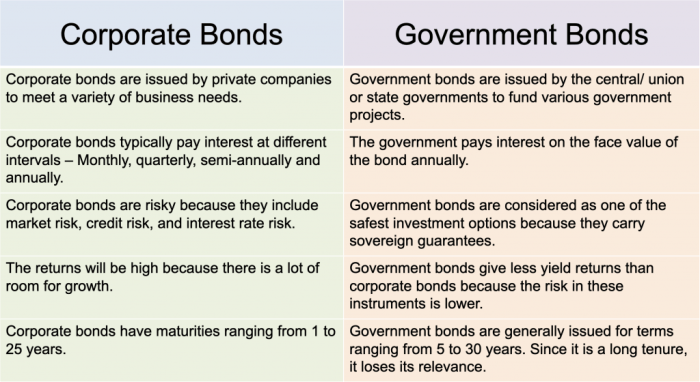
Government bonds and corporate bonds are two common types of fixed-income securities that investors can choose to invest in. Let’s explore the key differences between these two types of bonds.
Issuer
Government bonds are issued by the government at the national, state, or local level. These bonds are considered low-risk as they are backed by the government’s ability to tax its citizens to pay back the bondholders. On the other hand, corporate bonds are issued by corporations to raise capital for various purposes. These bonds carry a higher level of risk compared to government bonds as they are dependent on the financial health and performance of the issuing corporation.
Risk Levels
Investing in government bonds is generally considered less risky compared to investing in corporate bonds. Government bonds are backed by the full faith and credit of the government, making them a relatively safe investment option. On the other hand, corporate bonds are subject to default risk, as the issuing corporation may fail to meet its debt obligations. This default risk makes corporate bonds riskier than government bonds.
Returns or Yields
Government bonds typically offer lower returns compared to corporate bonds due to their lower risk profile. The yields on government bonds are influenced by factors such as interest rates, inflation, and the overall economic environment. On the other hand, corporate bonds offer higher returns to compensate investors for the additional risk they are taking. The yields on corporate bonds are influenced by the creditworthiness of the issuing corporation, market conditions, and the terms of the bond.
Government bonds
Government bonds are debt securities issued by a government to raise funds for various projects or expenses. These bonds are considered low-risk investments because they are backed by the government’s ability to tax its citizens to repay the bondholders. Government bonds are typically seen as a safe haven for investors seeking stable returns.
Issuance and Regulation
Government bonds are issued through a process known as a bond auction, where the government sets the terms of the bond sale, including the interest rate and maturity date. These bonds are regulated by government agencies such as the Treasury Department or the Central Bank to ensure transparency and adherence to regulations.
Types of Government Bonds
- Treasury Bonds: Long-term bonds issued by the government with maturities ranging from 10 to 30 years.
- Treasury Notes: Mid-term bonds with maturities between 2 to 10 years.
- Treasury Bills: Short-term bonds with maturities of less than one year.
Role in Financing Government Projects
Government bonds play a crucial role in financing government projects such as infrastructure development, healthcare, education, and other public initiatives. By issuing bonds, governments can raise capital without relying solely on tax revenues, spreading the cost of projects over time and diversifying funding sources.
Corporate bonds
Corporate bonds are debt securities issued by corporations to raise capital. Unlike government bonds, which are issued by the government, corporate bonds are issued by private companies looking to borrow money from investors.
Issuing Corporate Bonds
Corporate bonds are typically issued through an investment bank or underwriting firm, which helps the company determine the terms of the bond offering, such as interest rates, maturity date, and amount to be raised. The company then sells these bonds to investors in the open market.
Factors Influencing Credit Rating
The credit rating of corporate bonds is influenced by various factors, including the financial health of the issuing company, its ability to generate revenue and profits, its debt-to-equity ratio, market conditions, and overall economic environment. A higher credit rating indicates lower risk for investors.
Types of Companies Issuing Corporate Bonds
Various types of companies issue corporate bonds, including large corporations, medium-sized companies, and even small businesses. These bonds are used to fund business operations, expand operations, acquire new assets, or refinance existing debt. Companies from different industries such as technology, healthcare, finance, and energy are known to issue corporate bonds to raise capital.
Bond investment
When considering bond investment, there are several key factors that investors should take into account. These factors can help determine the suitability of a particular bond for their investment portfolio. It is essential to assess the credit quality of the issuer, the yield and maturity of the bond, the interest rate environment, and the overall risk tolerance of the investor.
Compare the liquidity of government bonds and corporate bonds
- Government bonds are generally considered to be more liquid than corporate bonds. This is because government bonds are backed by the full faith and credit of the government, making them less risky and more attractive to investors.
- Corporate bonds, on the other hand, may have lower liquidity due to the specific credit risk associated with the issuing corporation. Investors may find it more challenging to buy or sell corporate bonds quickly, especially during times of market volatility.
Provide examples of how bonds can be used to diversify an investment portfolio
- Bonds can be used to diversify an investment portfolio by providing a stable source of income and reducing overall portfolio risk. For example, an investor can allocate a portion of their portfolio to government bonds to offset the higher risk associated with stocks or other investments.
- Additionally, investors can diversify across different types of bonds, such as corporate bonds, municipal bonds, and treasury bonds, to further spread out risk and potentially increase returns.
In conclusion, the comparison between government bonds and corporate bonds sheds light on the distinct characteristics of each bond type, empowering investors to make strategic choices aligned with their financial goals. By understanding the nuances of these bonds, individuals can navigate the investment landscape with confidence and clarity.
Q&A
What is the main difference between government bonds and corporate bonds?
Government bonds are issued by governments, while corporate bonds are issued by corporations to raise capital.
Which type of bond generally carries higher risk: government bonds or corporate bonds?
Corporate bonds typically have higher risk levels compared to government bonds due to the financial stability of the issuer.
What are the typical returns investors can expect from government bonds and corporate bonds?
Government bonds usually offer lower returns but are considered safer, while corporate bonds provide higher potential returns with increased risk.