Delving into the world of bond investing, we uncover the potential risks and benefits that come with this financial endeavor, shedding light on crucial aspects that every investor should consider.
Exploring the intricate web of credit risk, interest rate risk, inflation risk, and default risk, we navigate through the complexities of bond investments to unveil key insights for making informed decisions.
Risks of bond investing
Investing in bonds comes with its own set of risks that investors need to be aware of in order to make informed decisions. Let’s delve into some of the key risks associated with bond investments.
Credit risk
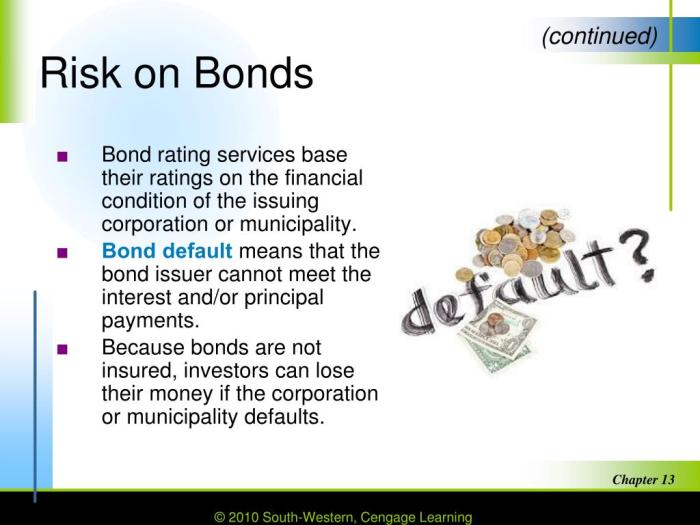
Credit risk is the risk that the issuer of the bond may default on its payments. This can happen if the issuer’s financial condition deteriorates, leading to a failure to make interest payments or repay the principal amount. Investors face the risk of losing their investment if the issuer defaults.
Interest rate risk
Interest rate risk refers to the impact of changes in interest rates on bond prices. When interest rates rise, bond prices fall, and vice versa. This means that if you need to sell your bond before it matures, you may receive less than the initial investment if interest rates have gone up.
Inflation risk
Inflation risk is the risk that the purchasing power of the bond’s returns will be eroded by inflation. If the rate of inflation exceeds the bond’s yield, the investor may end up with a negative real return. This can reduce the overall value of the investment over time.
Default risk
Default risk, also known as credit risk, is the risk that the bond issuer will not be able to meet its financial obligations. This can lead to a loss of income for the investor or even a loss of the principal amount invested. It is essential to assess the creditworthiness of the issuer to gauge the level of default risk associated with a particular bond.
Types of bond investments
Government bonds and corporate bonds are two common types of bond investments with distinct characteristics. Government bonds are issued by government entities and are considered low-risk investments since they are backed by the government’s ability to tax its citizens. On the other hand, corporate bonds are issued by companies to raise capital, making them slightly riskier than government bonds due to the higher chance of default.
Characteristics of municipal bonds
Municipal bonds are issued by state and local governments to fund public projects such as schools, hospitals, and infrastructure. These bonds are exempt from federal taxes and sometimes state taxes, making them attractive for investors in higher tax brackets. Municipal bonds are generally considered safe investments with lower yields compared to corporate bonds.
Comparison of high-yield bonds with investment-grade bonds
High-yield bonds, also known as junk bonds, offer higher interest rates to compensate for the increased risk of default. These bonds are issued by companies with lower credit ratings and are more susceptible to economic downturns. On the other hand, investment-grade bonds are issued by financially stable companies with higher credit ratings, offering lower interest rates but lower risk of default.
Features of convertible bonds
Convertible bonds give investors the option to convert their bonds into a predetermined number of shares of the issuing company’s stock. This feature provides investors with the opportunity to benefit from potential stock price appreciation while still receiving fixed income from the bond. Convertible bonds are attractive to investors seeking a balance between income and growth potential.
Factors influencing bond prices
When it comes to bond investing, there are several factors that can influence the price of a bond. These factors play a crucial role in determining the value of a bond in the market. Let’s delve into some key factors that impact bond prices.
Changes in interest rates
Changes in interest rates have a significant impact on bond prices. When interest rates rise, newly issued bonds come with higher yields, making existing bonds with lower yields less attractive. As a result, the prices of existing bonds decrease to align with the higher yields of new bonds. Conversely, when interest rates fall, existing bonds with higher yields become more desirable, causing their prices to increase.
Credit ratings
Credit ratings assigned to bonds by rating agencies also influence bond prices. Bonds with higher credit ratings are considered less risky investments, leading to higher demand and higher prices. On the other hand, bonds with lower credit ratings are perceived as riskier, resulting in lower demand and lower prices. Investors are willing to pay more for bonds with better credit ratings to offset the risk of default.
Market conditions
Market conditions such as economic indicators, inflation rates, and overall market sentiment can impact bond prices. For example, during periods of economic uncertainty, investors may flock to safer investments like bonds, driving up prices. Conversely, in a booming economy, investors may shift their focus to higher-risk, higher-return investments, leading to lower bond prices.
Maturity of a bond
The maturity of a bond also plays a crucial role in determining its price. Generally, longer-term bonds are more sensitive to changes in interest rates compared to short-term bonds. When interest rates rise, the prices of long-term bonds tend to decrease more significantly than short-term bonds. This is because investors prefer the flexibility of short-term bonds to reinvest at higher rates sooner.
Bond Investment Strategies
Passive bond investing strategies involve buying and holding a diversified portfolio of bonds to match a specific index, such as the Bloomberg Barclays U.S. Aggregate Bond Index. This approach aims to replicate the performance of the index rather than actively trading bonds.
Active Bond Investing
Active bond investing, on the other hand, involves actively managing a bond portfolio with the goal of outperforming the market or a specific benchmark. Fund managers make strategic decisions to capitalize on market opportunities and adjust the portfolio based on economic conditions, interest rate movements, and credit risk.
Bond Laddering
Bond laddering is an investment strategy where an investor builds a portfolio of bonds with staggered maturity dates. This approach helps to spread out reinvestment risk and provides a steady stream of income. The advantages include diversification, liquidity, and the ability to take advantage of interest rate fluctuations. However, the disadvantages include the potential for lower returns in a rising rate environment and the need for ongoing management.
Choosing Between Individual Bonds and Bond Funds
When deciding between individual bonds and bond funds, investors need to consider factors such as their investment goals, risk tolerance, time horizon, and the level of involvement they want in managing their portfolio. Individual bonds offer more control over maturity dates and cash flow, while bond funds provide diversification and professional management. Additionally, individual bonds may require a larger initial investment compared to bond funds, which can be more accessible to investors with smaller portfolios.
In conclusion, the risks associated with bond investing are multifaceted and demand careful consideration. By understanding and managing these risks effectively, investors can navigate the bond market with confidence, seeking out opportunities for growth and stability in their investment portfolios.
Detailed FAQs
What is credit risk in bond investments?
Credit risk refers to the likelihood of a bond issuer failing to make interest payments or repay the principal amount.
How does inflation risk impact bond investments?
Inflation risk erodes the purchasing power of fixed income received from bonds, reducing the real return on investment.
What are the differences between government bonds and corporate bonds?
Government bonds are issued by governments, while corporate bonds are issued by corporations. Government bonds are typically considered lower risk compared to corporate bonds.
What is bond laddering as an investment strategy?
Bond laddering involves staggering the maturity dates of bonds in a portfolio to manage interest rate risk and provide a more predictable income stream.